the Royal Exchange
The Royal Exchange, known colloquially as 'Change, stands as the epicenter of London's financial world in A Christmas Carol, a place where merchants gather, reputations are made, and the cold calculus of commerce reigns. It is the stage upon which Scrooge's identity as a man of business is both performed and judged, and its presence in the narrative marks the key moments of his moral and social trajectory.
The Seat of Scrooge's Business Identity
Scrooge's name is "good upon 'Change for anything he chose to put his hand to," a testament to his unimpeachable credit and the respect he commands in the world of finance. This standing is so solid that his signature on Marley's burial register is sufficient, and he solemnises the funeral itself "with an undoubted bargain." The Exchange is the arena where Scrooge's defining characteristic—his absolute devotion to business—is validated and where he feels most at home. It is the place he occupies "constantly," as he tells the charity gentlemen, and the standard by which he measures all human interaction. His nephew Fred's suggestion that he enter Parliament is a sarcastic acknowledgment of Scrooge's powerful, if narrow, command of this sphere.
The Scene of Callous Indifference
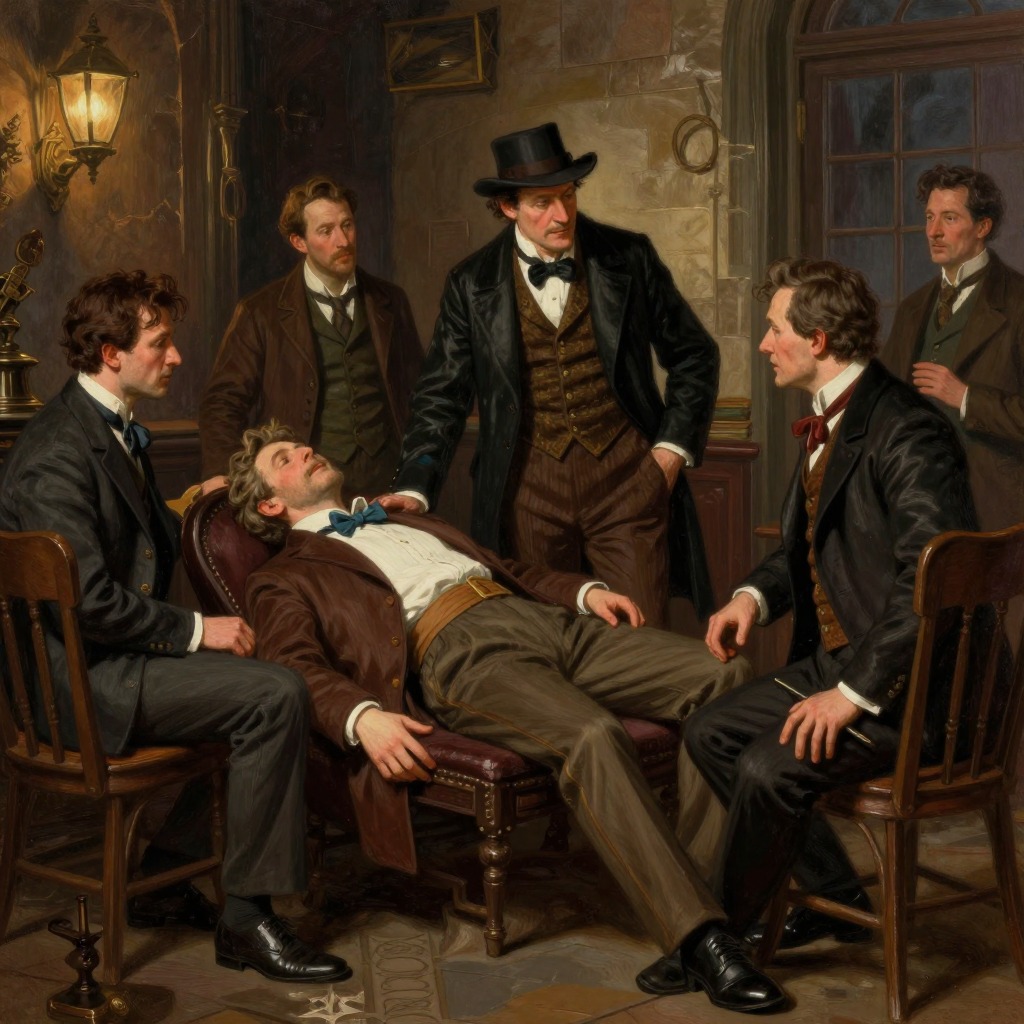
When the Ghost of Christmas Yet to Come leads Scrooge to the Royal Exchange, it is to witness the aftermath of a death—his own. The merchants, whom Scrooge knows perfectly, discuss the event with chilling indifference. A "great fat man with a monstrous chin" yawns as he reports the death, knowing only that "he's dead." Another man, with a "pendulous excrescence on the end of his nose," jokes about the deceased's money, while a third speaker, claiming to be "the most disinterested among you," offers to attend the funeral only if a lunch is provided. Their conversation is a series of callous pleasantries, revealing that in the world of 'Change, a man's death is merely a topic for idle gossip and a potential inconvenience. The only emotion the Ghost can show Scrooge caused by his death is one of pleasure, as seen in the relief of the debtors Caroline and her husband. This starkly contrasts with the warmth and grief of the Cratchit household, underscoring the spiritual poverty of a life lived solely for commerce.
The Site of Transformation and New Beginnings
Scrooge's final, triumphant return to the Exchange is the ultimate proof of his redemption. After his night of spiritual visitation, he encounters the portly gentleman who had solicited him for charity on Christmas Eve. Scrooge, now transformed, takes the gentleman by both hands, apologizes for his previous rudeness, and whispers a substantial donation in his ear, including "a great many back-payments." The gentleman, taken aback, can only stammer, "I don't know what to say to such munifi—" This act of generosity, performed in the very heart of the financial district, is a public declaration of his new values. The story concludes by affirming that Scrooge became "as good a man as the good old City knew," a final judgment that places his redemption within the very community that once knew him only as a miser. The Royal Exchange, therefore, is not merely a backdrop but a moral barometer, measuring Scrooge's fall and his rise.